

Katy's Getting a Nine-Court Pickleball Playground. Which Houston Club Model Actually Wins?
There’s a new pin about to drop on Houston’s pickleball map, and it’s a big, shiny one. Electric Pickle — an expanding chain of pickleball-and-dining “playgrounds” — is bringing nine high-tech courts to Katy, wrapped in golf simulators, bocce, pingpong, a live-music stage, and a restaurant with more than 8,000 square feet of patio dining. It’s the kind of venue that makes for a great Saturday night.
It also lands in a metro that has quietly become a national pickleball capital: Greater Houston reportedly has more pickleball facilities — 59 — than any other U.S. metro (Community Impact, Jan 23, 2026, citing Pickleball Magazine’s Sept/Oct 2025 count). Which means the interesting question isn’t “will Katy get another place to play?” It’s the one every operator in town should be asking right now: with three different kinds of pickleball club now competing for the same players, which model actually keeps them coming back?
Let’s start with the news, then zoom out.
What’s actually coming to Katy Grand
Electric Pickle is planning a venue with nine “high-tech” pickleball courts at 22590 Grand Circle Blvd., inside the Katy Grand development at Hwy 99 and the Katy Freeway (Community Impact, Jan 9, 2025). Beyond the courts, the plan calls for golf simulators, bocce ball, pingpong, gaming tech, and a stage for live music, plus a restaurant with 8,090 square feet of patio dining, per a Texas Department of Licensing and Regulation filing. The menu skews shareable and social — sushi, street tacos, pizzas, handhelds, and a drink list running from craft beer to spiked slushies (Covering Katy, Apr 15, 2025).
Two honest caveats. First, the timeline: officials and the company’s own materials say “opening in 2026,” but there’s no firm date — and Covering Katy noted the on-site construction sign still reads 2024, so treat the year as a target, not a promise. Second, the chain is young; Electric Pickle opened its first location in Tempe, Arizona in early 2025 and has announced sites in Las Vegas and Roseville, California. Katy would be an early Texas planting, not a proven local quantity.
File it under “promising, unconfirmed” — which is exactly how we’ve added it to our Houston facilities tracker.
Houston now has three kinds of pickleball club
Step back from any single ribbon-cutting and the metro’s venues sort cleanly into three species. Each is a different bet on how to make money from a paddle sport.
The membership big-box. Courts-first, dues-driven, built around reliable indoor play. Ace Pickleball Club is the clearest example — its Sugar Land club opened on schedule in April, joining Magnolia, with a third Houston-area location planned for Spring as a roughly $2.5M build targeted for 2027 (Community Impact, Apr 22, 2026). The Picklr is the other big name here, though its two Houston clubs — a 21-court flagship in The Woodlands and a smaller Cypress location — both still have no announced opening date as of mid-June (CultureMap, Apr 29, 2025; status re-checked June 15, 2026).
The eat-and-play (“eatertainment”) venue. Food and games are the front door; the courts are part of a night out. The model isn’t new to Houston — Chicken N Pickle has run it in Webster for a couple of years — but Electric Pickle is a bigger, splashier bet on it, and it’s aimed squarely at the booming Katy–Fulshear corridor. The pitch is high-margin food and beverage plus a low barrier to entry: you don’t need to be a 4.0 to have a great time.
The bar-first lounge. The glossiest version of the idea — pickleball as the backdrop to a premium social scene. It’s also the model that’s already been stress-tested locally, and it cracked: Solarium, a Midtown “luxury pickleball lounge,” closed permanently after about a year in business (CultureMap, Apr 4, 2026). We’re not here to diagnose why one venue closed — but the contrast is hard to ignore.
Houston already gave us a hint
Here’s the pattern worth sitting with: in roughly the same window that a bar-first Midtown concept folded, the membership big-boxes kept opening and a new eat-and-play complex lined up in Katy. Demand was never Houston’s problem — this is the country’s most facility-rich pickleball market. Delivery and durability are the problem. The model is the variable.
To be fair to every camp, each model has a real case. The membership big-box sells certainty: a guaranteed court at your level on a Tuesday night in July, which is worth a lot when it’s 99 degrees and the public courts are full. Eat-and-play venues genuinely pull in new players and lucrative food-and-beverage revenue, and they’re the best on-ramp the sport has for someone who’d never sign up for “league night.” Even the bar-and-lounge model isn’t wrong that pickleball is social — it just leaned hardest on amenities, which are the easiest thing for a competitor to copy and the most expensive thing to keep running as costs climb. The argument we’ll make below — community is the asset, amenities aren’t — is the Houston field test of an idea every operator in this metro is now running, whether they meant to or not.
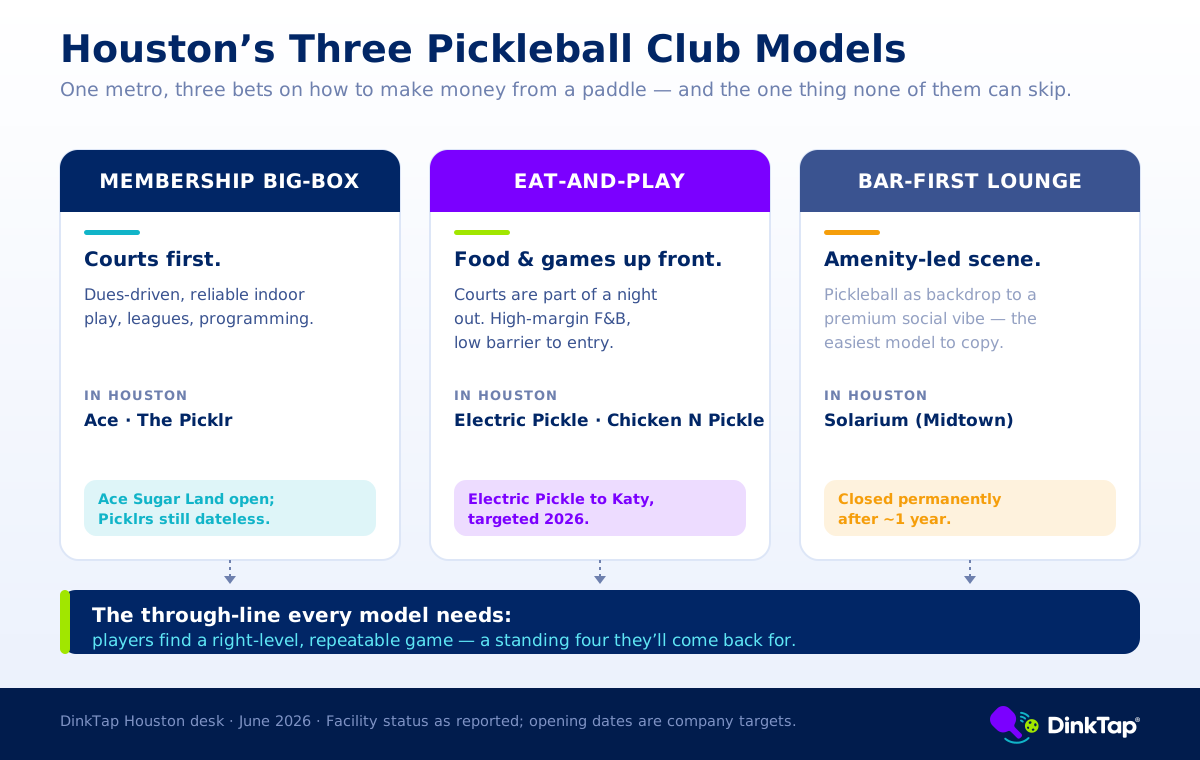
Three business models, one thing they can’t skip. Facility examples: DinkTap Houston desk reporting, June 2026.
Our take
(This part is DinkTap’s opinion, clearly labeled — and we’ll be upfront that we’re talking our book.)
The model is a smaller predictor of success than the thing all three keep treating as an afterthought: whether a member actually finds their people.
You can win or lose with any of these formats. A membership big-box dies if its open play is a chaotic free-for-all where a nervous 3.0 keeps getting bagel’d by a 4.5. An eat-and-play palace prints money on Friday but turns into an empty box on Wednesday if nobody on those nine courts has a reason to come back without a dinner reservation. And the splashiest lounge in Houston can’t out-amenity the simple fact that people return to where their game is. The single most reliable predictor of whether a new player sticks isn’t the espresso machine or the slushie menu — it’s whether they found a few regular partners at their level in the first month. Lock in a standing Thursday four, and you’re a member for years. Wander off because you could never find a fourth, and no amount of LED lighting brings you back.
That’s the bet DinkTap® is built on, and it’s why we care less about which model wins than about whether each club nails the connective tissue underneath it. Our whole job is helping players find compatible, right-level partners — swipe-to-match discovery, DinkType™ doubles-chemistry profiles, and the Dynamic Mesh Rating™ (DMR) for an honest read on level so games stay competitive. (DMR complements skill ratings like DUPR; it doesn’t replace them, and DinkType is our own framework, not a diagnosis or independent research.) You don’t need our app to do this — a leveled open-play rotation and a whiteboard get a long way. You just need to treat “do players find their people here?” as a core operating metric, not a happy accident.
For Houston’s club builders: one filter before the next big spend
Katy’s new playground will be fun, and there’s a real audience for a night of courts, sliders, and spiked slushies. But if you operate — or are about to build — a club in the country’s most competitive pickleball market, run your next dollar through a single question: does this help members connect, or just impress them on the tour? A few low-capital moves that punch above their cost:
- Make open play level-based. Sorting courts by skill is the cheapest retention upgrade in the building. Better-matched games are more fun, and fun is what brings people back Wednesday.
- Run a real beginner on-ramp. Weekly beginner nights turn nervous first-timers into regulars before they decide the sport “isn’t for them” — and eat-and-play venues are perfectly built for this.
- Engineer the introductions. Level-based mixers, ladders, and a dead-simple “find a partner near your level” path do more for renewals than another screen on the wall.
- Reward your connectors. Your most social members are your best marketers; a light ambassador program turns them into recruiters.
Build the nice facility if the numbers work — Houston players notice quality, and that’s real. Just don’t confuse the amenities with the asset. Three club models are about to go head-to-head across the metro, and the one that wins won’t be the one with the longest menu. It’ll be the one where the most people can text three friends and say, same time next week?
Partner with DinkTap →
Sources & further reading
- Community Impact — “Electric Pickle to open its doors in Katy in 2026” (Jan 9, 2025): nine high-tech courts, amenities, 8,090 sq ft of patio dining (per a TDLR filing), 22590 Grand Circle Blvd., and the chain’s Tempe/Las Vegas/Roseville footprint.
- Covering Katy — “Luxury Pickleball Entertainment Complex Electric Pickle Coming to Katy Grand” (Apr 15, 2025): the “opening 2026” target, the dated construction sign, menu and concept detail.
- Community Impact — “Katy-Fulshear area sees pickleball boom” (Jan 23, 2026): the local build-out and the Pickleball Magazine (Sept/Oct 2025) figure ranking Greater Houston first nationally with 59 facilities.
- Community Impact — “Ace Pickleball Club sets opening date for Sugar Land location” (Apr 22, 2026): Ace’s Sugar Land opening and Spring/Magnolia context.
- CultureMap — “Pickleball venue Picklr opening in Cypress and The Woodlands” (Apr 29, 2025): the two Houston Picklr clubs.
- CultureMap — “Solarium … closed” (Apr 4, 2026): the Midtown lounge’s permanent closure after about a year.
A note on sourcing: facility details and timelines above come from local trade reporting (Community Impact, Covering Katy, CultureMap) and a Texas Department of Licensing and Regulation filing; forward-looking opening dates are company targets, not confirmed dates, and are labeled as such. The “Greater Houston is #1 with 59 facilities” figure is a Pickleball Magazine (Sept/Oct 2025) count as reported by Community Impact, and refers to facilities, not courts. We report the closure of Solarium as fact and do not speculate on its causes. DMR and DinkType™ are DinkTap’s own player-matching frameworks, offered as tools for connection — not independent research or a diagnosis. Published June 15, 2026.